

Braided & Loomed Wire Harness Manufacturing
WHAT WE DO
In-House Braiding & Loom Application
Protection engineered into every harness
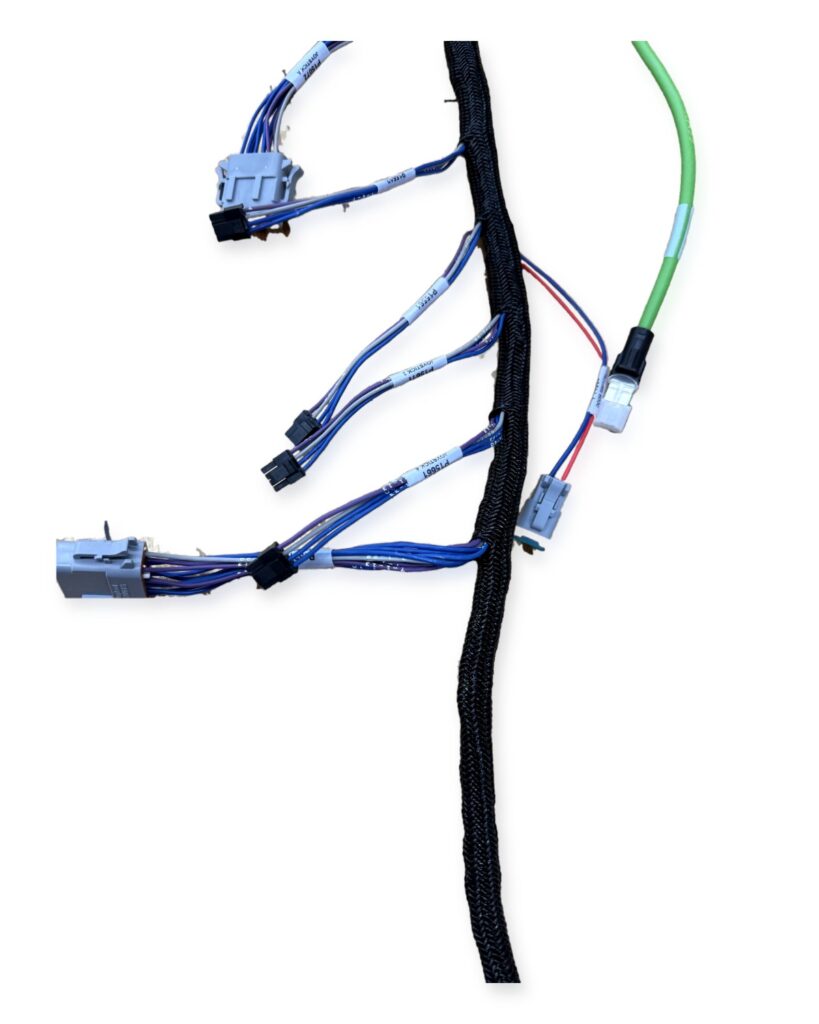
Braiding and loom application aren’t afterthoughts we send out. They’re integrated steps in how we build harnesses, done in-house on multiple wire harness braiding machines that handle a wide range of harness lengths and diameters. That matters, because the covering on a harness is what defends it against the real world: abrasion, vibration, heat, moisture, and the snagging that comes with tight routing in a machine. Get it right and the harness lasts. Get it wrong and you’re looking at a field failure that a few cents of protection would have prevented.
We apply braiding and protective coverings across demanding applications, including heavy equipment, agricultural machinery, marine-grade builds, and industrial systems. Each covering is matched to the environment the harness has to survive.
PROTECTION OPTIONS
Harness Covering & Sleeving Options
Matching the covering to the environment
Different environments call for different protection. The most common options we apply:
- Braided sleeving: excellent abrasion resistance, flexibility, and a clean professional finish; the premium choice for harsh-duty applications
- Split loom / convoluted tubing: economical protection with easy access for service and routing
- Spiral wrap: flexible protection that accommodates breakouts along the run
- Heat shrink and strain relief: sealing and mechanical protection at terminations and transitions
- Wire harness tape: cost-effective, flexible protection from abrasion, noise, heat, and age
Not sure which is right? A quick look at where and how the harness will be routed usually tells the story. It’s a conversation we’re glad to have during quoting, before anything is built.

Talk to us about your requirements and project goals!
WHEN TO BRAID
Braided vs. Loomed: Choosing the Right Approach
Function first, appearance second
It’s easy to assume braiding is about looks. It isn’t, or at least not only. The decision to braid, loom, or wrap a harness is a functional one, driven by the abrasion, heat, and flex the assembly will face. (Our article on braided wire harnesses breaks down the trade-offs in detail if you want to go deeper.) Where we add value beyond the theory is in the recommendation: during quoting and NPI, we help you match the covering to the application so you’re paying for the protection you need. No more, no less. That’s the quality-control mindset applied to cost, not just to the build.
QUALITY CONTROL
Consistent Coverage, Tested Assemblies
Braided harnesses that hold up in the field
Protection only works if it’s applied consistently, so we hold process controls on braid coverage and loom fit across every assembly. And a braided harness is still a harness: it receives the same automated pull testing and continuity and functional testing as everything we build, to IPC/WHMA-A-620 workmanship under our ISO 9001:2015 quality management system. Specialty wire, including high-temperature and marine-grade, is well within our experience.
Braided & Loomed Harness FAQs
Braided sleeving offers the best abrasion resistance and finish and suits harsh-duty applications; split loom is a more economical option that’s easy to open for service. The right pick depends on the environment and how often the harness needs to be accessed.
It adds some cost, but usually far less than a field failure caused by an unprotected harness. We help you weigh protection against budget so the covering fits the application.
Yes. We build to print and can apply the covering materials your specification calls for.
In-house. We run multiple wire harness braiding machines on-site, so we can cover a wide range of harness lengths and diameters while keeping coverage consistent and lead times short.