
Large & Complex Industrial Wire Harness Assembly
WHAT WE DO
Industrial Wire Harnesses Few Shops Can Build
50+ feet, multiple breakouts, mission-critical reliability
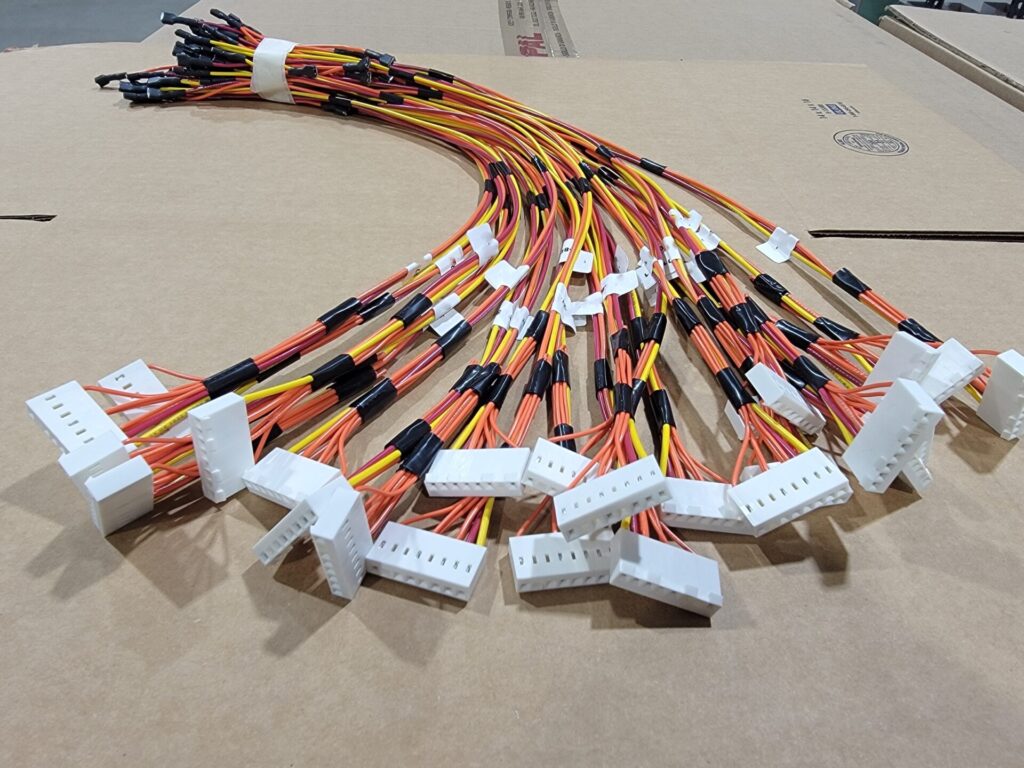
Some harnesses are straightforward. These aren’t the ones we’re talking about. We build the large, complex, high-conductor-count harnesses that demand skilled technicians, strict process controls, and the ability to read and interpret detailed assembly prints. Our harnesses run 50 feet and beyond, and we don’t cap breakouts or circuit counts. Whether your build has 10 breakouts or 200, we have you covered. They’re laid out on dedicated harness boards, documented and tested step by step, and built to survive the toughest environments in the field.
This is the work that keeps heavy machinery running, from construction and forestry equipment to the rigs that harvest crops across the Midwest. On that kind of equipment, a harness failure isn’t a nuisance. It’s downtime, lost productivity, and a machine that’s dead in the dirt. That’s why OEMs with their most demanding assemblies have brought them to us for more than three decades.
Have a complex harness print? Let’s review it together.
CAPABILITIES
Industrial Wiring Harness Capabilities
Every discipline under one roof
Large, complex harnesses usually pull in several disciplines at once. We have them all in-house:
- Braiding and loom application for abrasion, heat, and vibration protection
- Ultrasonic welding and butt splicing
- Wire marking and labeling for complex breakouts
- Automated pull testing and continuity and functional testing
- Specialized handling and packaging for large, heavy harnesses
- Specialty wire experience: high-temperature and marine-grade, 26 AWG to 250 MCM
All of it runs under strict process controls and IPC/WHMA-A-620 workmanship, so complexity never comes at the cost of consistency.

Talk to us about your requirements and project goals!
OUR PROCESS
The NPI Process for Complex Harness Builds
Proven steps that de-risk your most difficult assemblies
The bigger and more complex the harness, the more a disciplined process matters. Ours starts with your bill of materials, which our engineers review to determine true wire lengths from the actual bends and breakouts. Those lengths often differ from the original prints. From there we build a detailed cut sheet, then lay out and document a New Product Introduction (NPI) build on a harness board. For complex assemblies, you approve that NPI build before we move to full production. Adjustments are captured through Engineering Change Notices, and continuity testing confirms every route is correct.
The payoff is simple math: catching a routing error at NPI costs a few hours. Catching it after the harness is installed in a machine costs a great deal more. Our process, and the experience behind it, is built to find problems here, not in your customer’s field.
INDUSTRIES
Built for the Toughest Applications
Heavy equipment, agriculture, construction, and beyond
Our large and complex harnesses go into the equipment that has to work no matter what:
- Heavy equipment: harnesses for machines built to move earth, harvest, and haul. (See our Spudnik case study, supporting North America’s largest potato-equipment company.)
- Agricultural equipment: durable, flexible assemblies engineered for temperature extremes, UV, and constant motion.
- Industrial controls: reliable interconnects for demanding industrial systems.
- Aerospace: wiring assemblies for applications where traceability and reliability are non-negotiable.
Complex Wire Harness FAQs
Usually a combination of length, the number of breakouts and terminations, the connector count, and the range of disciplines required: braiding, welding, splicing, and specialized testing. Complex harnesses reward experience and strict process control, which is where we focus.
We don’t set a minimum or maximum on breakouts or circuits. Whether your harness has 10 breakouts or 200, we have you covered. We regularly build harnesses that run 50 feet and beyond, and we have the handling and packaging to move large, heavy assemblies without damage.
Through our NPI process: engineering review of true wire lengths, a documented NPI build you approve before production, Engineering Change Notices for any adjustments, and continuity testing to confirm correct routing.
Heavy equipment, agriculture, construction, and industrial machinery most often, plus anywhere a harness has to perform reliably in a harsh, high-vibration environment.
Yes. High-mix, low-to-medium-volume work is our specialty, including short runs of critical, complex assemblies.