
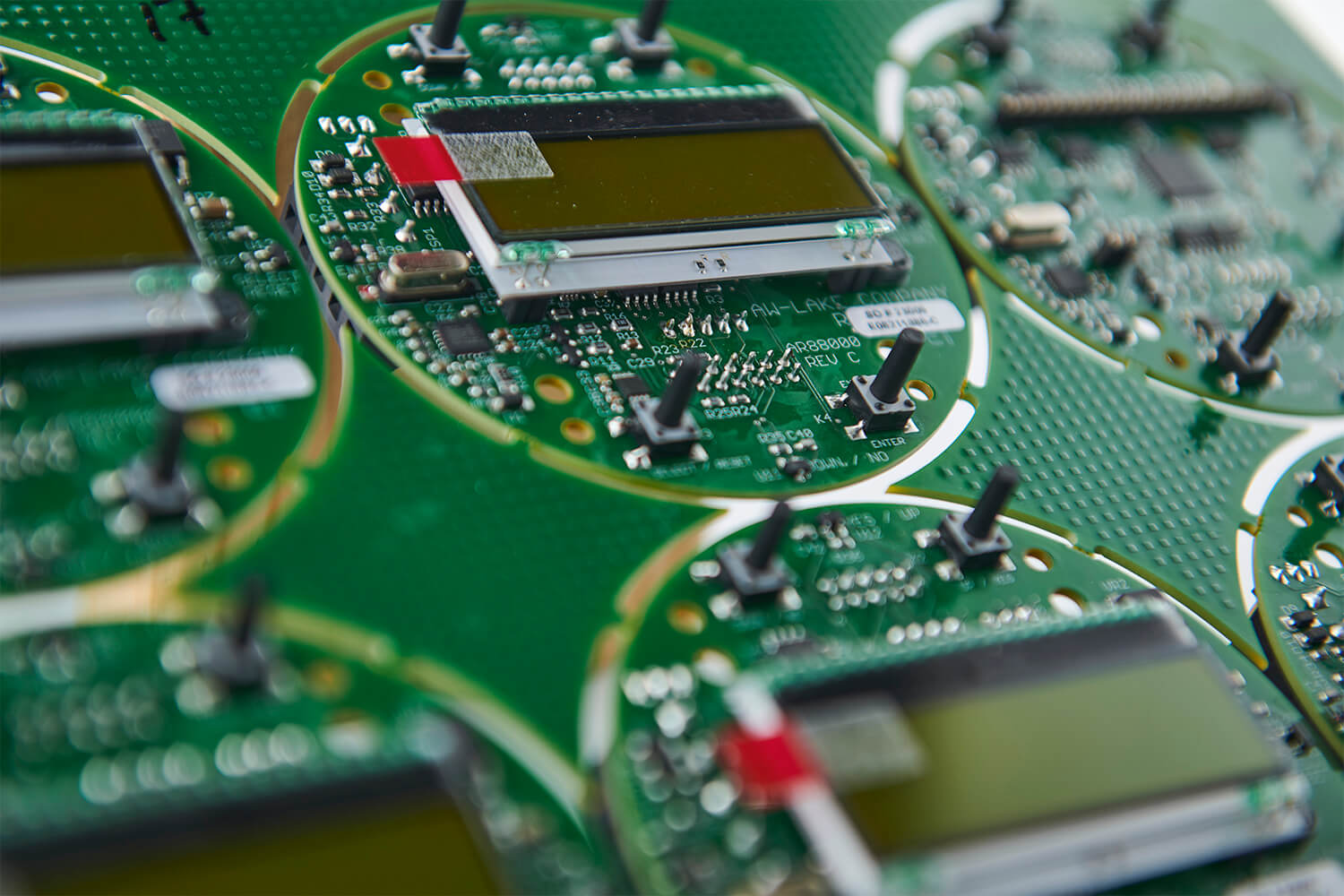
Multi-Zoned Full Forced Convection Reflow Ovens for Precise PCB Soldering
BUILT FOR ACCURACY
Thermal Control for High-Reliability Assemblies
Reflow is where everything that came before it — solder paste application, stencil alignment, component placement gets validated. At ETI, our multi-zoned full forced convection reflow ovens give our process engineers the thermal control required to run complex, high-reliability assemblies through a precisely profiled reflow cycle, board after board, without deviation.
WHY IT MATTERS
What a Convection Reflow Oven Actually Does — and Why Zones Matter
For engineering managers who specify assemblies for demanding applications, understanding what separates a well-controlled reflow process from an adequate one starts with the oven architecture.
A convection reflow oven moves populated PCBs through a series of independently controlled temperature zones on a conveyor. Each zone serves a distinct thermal purpose: preheat zones ramp the board gradually to avoid thermal shock, soak zones stabilize temperature across the board’s thermal mass, reflow zones bring the assembly to peak temperature to turn the solder paste into a liquid and flow the solder paste, and cooling zones return the board to handling temperature in a controlled descent that promotes proper joint formation and prevent thermal shock. The number of zones determines how precisely that thermal curve can be shaped.
A limited-zone oven forces compromises — steeper ramps, less stable soaks, less control over peak temperatures on thermally complex boards. A multi-zone convection reflow oven, such as ETI’s 10-zone units (8 heat zones and 2 cooling zones), gives process engineers the resolution to craft a profile that satisfies the thermal requirements of every component on the board simultaneously — from small passives with low thermal mass to large connectors, shields, and power components that absorb heat differently.
Full forced convection — as opposed to infrared or hybrid IR/convection designs — uses high-velocity heated air to transfer energy uniformly across the board surface. This eliminates the shadowing effects and uneven heating that IR-dominant systems can produce on boards with mixed component heights and densities, and it’s the preferred approach for the complex mixed-technology assemblies that make up the majority of ETI’s production.
HOW IT WORKS
How ETI’s Reflow Process Works
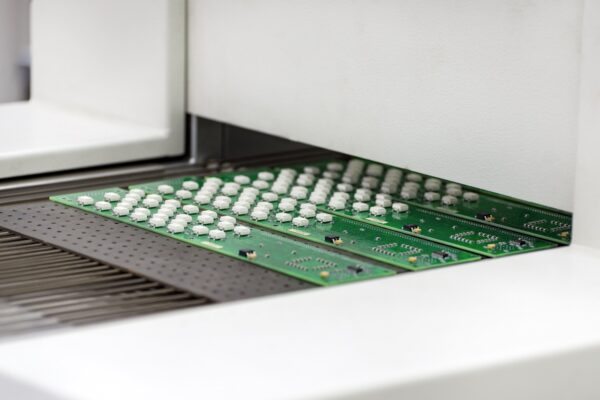

Thermal Profile Development
Before a single production board enters the oven, our process engineers develop and validate a thermal profile specific to your assembly. Board thickness, copper weight, component density, thermal mass distribution, and solder paste specification all inform how each zone is set. We target the reflow window defined by your paste manufacturer — minimum temperature for complete reflow, maximum temperature for component safety — and validate the profile with thermocouple measurements across multiple board locations.

Controlled Ramp, Soak, Reflow, and Cooling
Our multi-zone architecture allows each phase of the reflow curve to be independently controlled. Ramp rates are kept within paste specification limits to avoid slump, voiding, or solder balling. Soak zones allow the board’s thermal mass to equilibrate before entering the reflow zone — critical for assemblies with components of significantly different sizes. Cooling rates are controlled to promote fine grain solder joint microstructure and avoid thermal stress cracking.

PCB Reflow Temperature Management
PCB reflow temperature is not a single number — it’s a window, and managing the entire board within that window simultaneously is the engineering challenge. On a dense, thermally varied board, the coldest joint must reach minimum reflow temperature while the hottest component must not exceed its maximum rated temperature. Our multi-zone forced convection ovens give us the zone resolution to manage that delta across complex assemblies.

Leaded and RoHS-Compliant Profiles
ETI runs both leaded (Sn63Pb37) and lead-free (SAC305 and equivalents) reflow profiles. Lead-free alloys demand higher peak temperatures — typically 235–250°C — and tighter process windows than leaded assemblies. Our oven capabilities and profiling discipline support both without compromise.
Why Full Forced Convection Is the Right Architecture for Complex Boards
The PCB assemblies ETI builds for medical devices, aerospace electronics, HVAC systems, and industrial controls aren’t simple boards with uniform component populations. They’re mixed-technology designs with a range of component sizes, thermal masses, and temperature sensitivities that have to coexist through the same reflow cycle.
Full forced convection reflow—paired with a nitrogen atmosphere—handles this better than any alternative. High-velocity convective airflow wraps around component bodies and reaches under low-standoff devices, transferring heat more uniformly than infrared radiation, which heats surfaces in line-of-sight patterns. The nitrogen environment further enhances the process by reducing oxidation during reflow, improving solder wetting, and supporting more consistent joint formation.
For fine-pitch BGA packages, bottom-terminated components, and tight-pitch QFN devices—the kinds of components increasingly common in high-reliability designs—uniform thermal transfer isn’t a preference, it’s a process requirement.
The result is a process that produces consistent, well-formed solder joints with minimal voiding, strong wetting, and the joint microstructure needed to support long-term reliability in demanding operating environments.
Reflow as Part of an Integrated PCBA Process
The reflow oven doesn’t operate in isolation at ETI. It’s the third step in a fully integrated SMT line that begins at screen printing and ends at 3D Automated Optical Inspection — and every step informs the next.
Solder paste deposited at screen printing with controlled volume and geometry enters reflow with predictable behavior. Boards exit reflow and pass directly to our 3D Automated Optical Inspection system, where every joint is evaluated in three dimensions against a known-good standard. Defects caught at AOI trace back to either print or reflow — and because both processes are managed by the same team with documented parameters, root cause is identifiable and correctable quickly.
For through-hole components not processed in reflow, boards route to our selective soldering or wave soldering systems before returning to the inspection line. Every handoff is internal. Every process parameter is documented. That’s what ISO 9001:2015 certification means in practice — not a plaque on the wall, but a traceable, auditable process from paste to final inspection.
Key Benefits
Key Benefits of ETI’s Reflow Capabilities
Thermal Precision Across Complex Boards
Multi-zone architecture gives our engineers the resolution to manage PCB reflow temperature across assemblies with significant thermal mass variation — protecting sensitive components while ensuring complete reflow on higher-mass joints.
Validated Profiles, Not Estimated Ones
Every new assembly gets a profiled and validated thermal curve before production. You’re not relying on a generic profile that gets your board close — you’re running a profile built for your specific design.
Consistent Results at Small and Mid Volumes
ETI’s process discipline applies equally to a 50-board NPI run and a 1,500-board production release. The same oven, the same profile, the same documented parameters. Your validation build data is production-representative — which is the entire point of the NPI process.
Support for Both Leaded and Lead-Free
Whether your assembly requires leaded solder for legacy compatibility or RoHS-compliant lead-free processing for regulatory requirements, ETI’s reflow capabilities support both with validated profiles and appropriate thermal management.
Direct Path to Inspection
Boards exit reflow and enter 3D AOI without leaving ETI’s facility or changing hands. Joint quality is verified immediately after reflow, when correction is still straightforward — not after the board has been shipped, built into a system, and returned as a warranty claim.

Ready to Talk Through Your Reflow Requirements?
If you’re designing a new assembly, troubleshooting a reflow yield problem, or evaluating a contract manufacturing partner for a high-reliability application, ETI’s engineering team is ready to get specific with you. Bring your board complexity — we’ve seen it before.