The terms “wire harness” and “cable assembly” get used interchangeably in engineering conversations, procurement documents, and product specifications — often by people who work with both every day. The distinction matters, though, because wire harnesses and cable assemblies are engineered for different purposes, perform differently under different conditions, and are the right answer in different applications.
Understanding where those differences lie is the first step toward specifying the right solution for your product — and avoiding the downstream cost of getting it wrong.
Wire vs. Cable: Starting With the Basics
Before comparing harness cable assemblies and cable assemblies directly, it helps to establish the underlying terminology, because even “wire” and “cable” mean different things.
A wire is a single strand — or a bundle of strands — of conductive material, typically copper or aluminum, with an insulating jacket around it. A cable bundles two or more insulated wires together within a single outer jacket. The jacket holds them together and provides a first layer of shared protection.
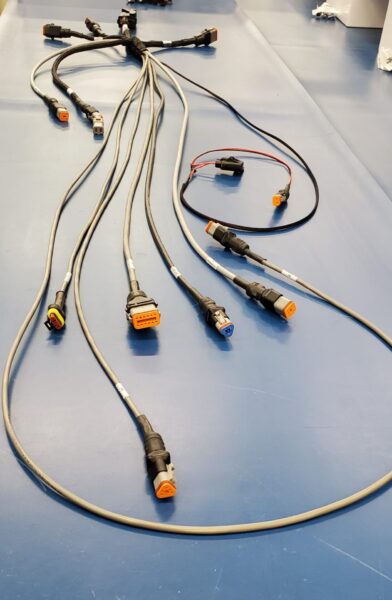
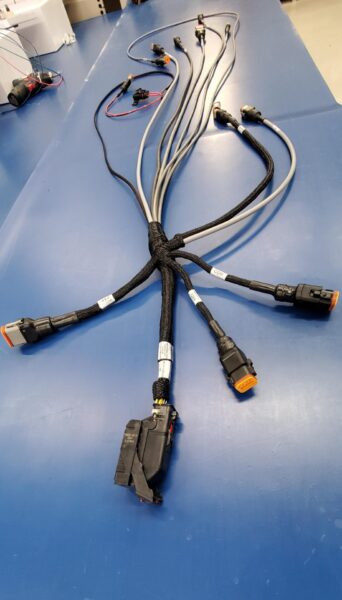
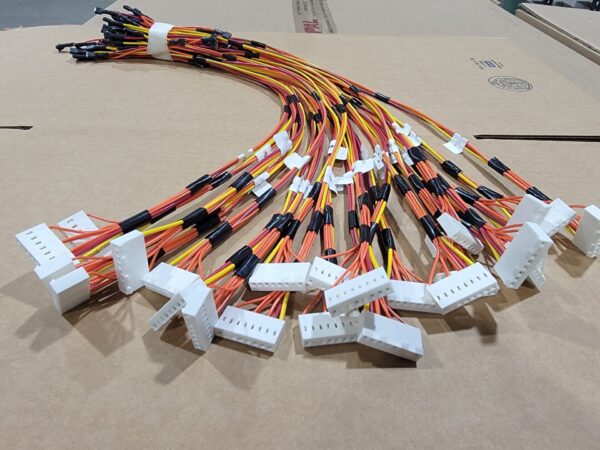
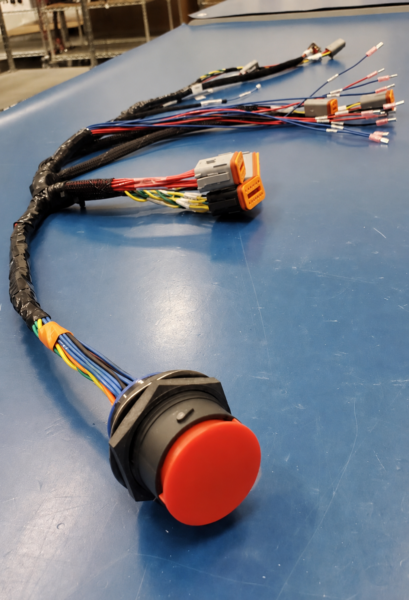
A wire harness — sometimes called a cable harness or wiring harness — organizes multiple individual wires and cables into a routed, bound assembly. The harness holds everything in a defined physical arrangement using loom, lacing, cable ties, sleeves, or tape. Individual conductors within the harness remain accessible and separable.
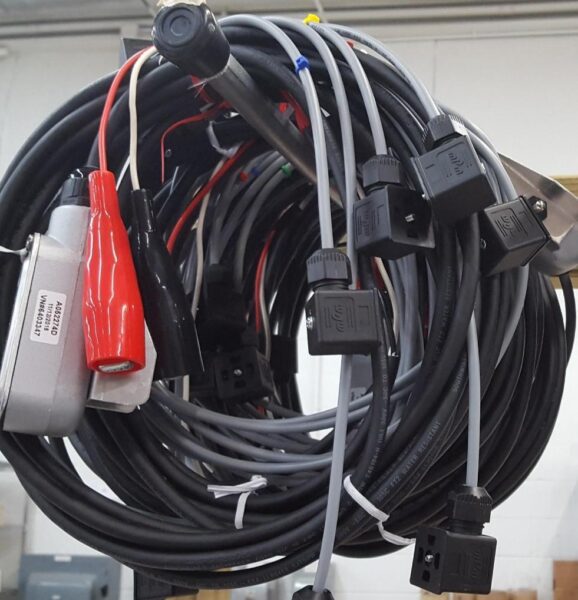
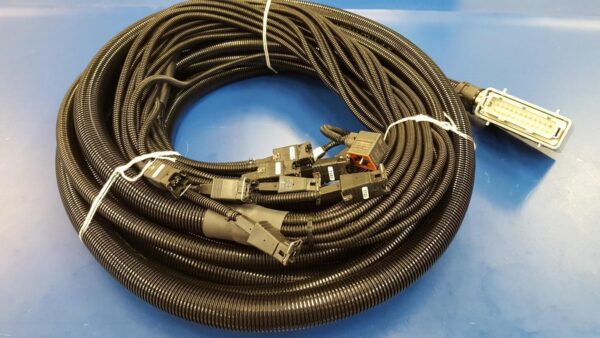
A cable assembly takes a different approach. Multiple wires are encased together within a single, robust outer sleeve — thermally bonded, shrink-wrapped, or overmolded — into what is effectively one unified component. The internal conductors are not independently accessible without cutting into the assembly.
That fundamental structural difference — organized and accessible vs. unified and protected — drives most of the practical differences between the two.
Protection vs. Organization: The Core Distinction
The most important functional difference between cable assemblies and wire harnesses comes down to what each one is primarily engineered to do.
Wire harnesses are optimized for organization. They route multiple conductors efficiently through a defined space, reduce installation complexity, and make it easier to manage wiring in assemblies where access and serviceability matter. The binding material — conduit, braiding, loom, or tape — keeps the conductors bundled and routed without significantly altering their individual characteristics or environmental exposure.
Cable assemblies are optimized for protection. The outer sleeve — typically vinyl, thermoplastic rubber (TPR), polyurethane, or shrink-wrapped thermoplastic — is engineered as an environmental barrier. It shields the internal conductors from moisture ingress, UV exposure, chemical contact, abrasion, compression, and thermal extremes. The assembly behaves as a single, ruggedized component rather than a collection of individual conductors.
This distinction matters most when you’re specifying for an application where the wiring will be exposed to conditions the conductors themselves can’t tolerate on their own.
Environmental Suitability: Outdoor vs. Indoor Applications
Environmental conditions are the most common driver of the wire harness vs. cable assembly decision, and the general rule is straightforward: cable assemblies for outdoor and harsh-environment applications, wire harnesses for protected indoor environments.
Cable assemblies are built to withstand the variables that degrade electronics in the field — moisture and condensation, temperature extremes, UV radiation, chemical exposure, vibration-induced abrasion, and physical impact. The outer sleeve material is selected specifically for the application environment. Vinyl handles general outdoor exposure well. TPR adds flexibility at low temperatures. Polyurethane resists oils and fuels. Overmolded assemblies with sealed connector interfaces provide IP-rated ingress protection for submersion or high-pressure washdown environments.
For applications where the wiring is routed through equipment that operates outdoors, underground, in a vehicle, in a marine environment, or in an industrial setting with chemical or mechanical hazards, cable assemblies provide the environmental protection that wire harnesses simply aren’t designed to deliver.
Wire harnesses are well-suited for applications where the wiring operates inside a protected enclosure — a chassis, a cabinet, a housing, or a controlled indoor environment. Consumer electronics, household appliances, HVAC equipment in climate-controlled buildings, computers, monitors, and similar products all use wire harnesses because the product’s own enclosure provides the environmental protection the wiring needs. The harness’s job in these applications is organization and routing, not environmental sealing.
The caveat worth noting: many real-world assemblies don’t fall cleanly into one category. A product that operates primarily indoors but includes connectors or routing paths exposed to moisture, cleaning chemicals, or temperature variation may need cable assemblies at those specific interfaces even if the internal wiring uses a harness architecture. A knowledgeable contract manufacturer evaluates the full routing environment, not just the general use case.
Harness Cables and Mixed-Technology Assemblies
In practice, harness cable assemblies frequently incorporate both approaches within a single, more complex wiring system. A large equipment assembly might use wire harnesses to organize internal wiring runs through a protected chassis while using cable assemblies for any runs that exit the enclosure, connect to external sensors, or route through areas exposed to vibration, moisture, or mechanical contact.
This is where the distinction between “wire harness” and “cable assembly” becomes less about choosing one over the other and more about understanding which approach serves each segment of the wiring architecture. An experienced engineering and manufacturing partner helps specify that boundary correctly — during the design phase, before tooling and materials are committed.
Material Selection for Harness Cable Assemblies
The outer jacket or binding material in both wire harnesses and cable assemblies does more than hold things together — it defines the assembly’s performance envelope. Material selection should be deliberate and driven by the application environment, not just by what’s available or familiar.
Common wire harness binding materials: Conduit, spiral wrap, and braided sleeving provide organization and basic abrasion resistance. Lacing cord and cable ties are used for routing and bundling in clean, low-stress environments. Corrugated tubing adds flexibility and modest environmental protection in semi-protected applications.
Common cable assembly jacket materials: Vinyl (PVC) is cost-effective and suitable for general outdoor and industrial use. Thermoplastic rubber (TPR) adds flexibility at low temperatures and better impact resistance. Polyurethane resists oils, fuels, and abrasion — well-suited for mobile equipment and automotive-adjacent applications. Cross-linked polyethylene (XLPE) handles high temperatures and harsh chemical environments. Silicone jacket materials extend the thermal range further for high-heat applications. Overmolded thermoplastic at termination points provides strain relief and, with proper sealing, ingress protection at the most vulnerable points of the assembly.
Conductor material, insulation type, shielding configuration, and termination method are equally important selection criteria — particularly for signal-carrying assemblies where EMI shielding, impedance control, or high-frequency performance are design requirements.
Industry Applications: Where Each Is Used
Industries and Applications That Commonly Use Cable Assemblies
Heavy-duty and harsh-environment industries rely on cable assemblies where wiring is exposed to the conditions the outer jacket is designed to resist.
Heavy equipment and construction applications route cable assemblies through frames, along exteriors, and across articulation points where vibration, abrasion, and exposure are unavoidable. Military and defense applications demand cable assemblies that meet stringent environmental and EMI specifications — MIL-SPEC cable assemblies are a well-defined category with their own material and testing requirements. Agricultural equipment operates in environments combining moisture, dust, UV exposure, fertilizer and pesticide contact, and mechanical vibration — conditions that require the full protection a properly specified cable assembly provides.
Aerospace applications use cable assemblies where weight, EMI performance, environmental sealing, and long service life are simultaneous requirements. Medical device applications use cable assemblies extensively — particularly for patient-connected and imaging equipment where fluid exposure, repeated sterilization, and high-speed data transfer requirements drive the specification toward high-performance cable assembly architectures.
Industries and Applications That Commonly Use Wire Harness Assemblies
Wire harnesses are the dominant wiring solution in applications where the product’s own enclosure provides adequate environmental protection and where organized, serviceable routing is the primary engineering requirement.
Consumer electronics — computers, televisions, monitors, and similar products — use wire harnesses to manage internal wiring within housings that handle environmental protection at the product level. Home appliances like refrigerators, dishwashers, and microwaves use wire harnesses for the same reason: the appliance enclosure is the environmental barrier.
Automotive applications use wire harnesses extensively for interior and under-hood routing where the vehicle body provides protection — though exterior and underbody routing often transitions to cable assemblies at the interfaces exposed to road debris, moisture, and temperature extremes. Commercial HVAC equipment and industrial control panels use wire harnesses for internal wiring organization within protected enclosures.
How to Choose: Wire Harness or Cable Assembly?
The decision framework is straightforward once the application environment is understood:
Choose a cable assembly when the wiring will be exposed to moisture, temperature extremes, UV radiation, chemicals, abrasion, or mechanical impact. When the conductors route outside a protective enclosure. When IP-rated ingress protection is required. When the assembly is in a mobile, outdoor, marine, or industrial environment. When long service life under adverse conditions is a design requirement.
Choose a wire harness when the wiring operates entirely within a protected enclosure. When organization, routing efficiency, and serviceability are the primary requirements. When the application environment is controlled — indoor, clean, and within a normal temperature range. When access to individual conductors for maintenance or reconfiguration is a design consideration.
Engage a contract manufacturer early when your application spans both categories, when environmental requirements aren’t fully defined yet, or when the wiring architecture is complex enough that the harness/cable boundary needs to be engineered rather than assumed. Design for Manufacturability (DFM) review of wiring architecture — before tooling is committed — is where the most consequential decisions get made at the lowest cost.
ETI’s Wire Harness and Cable Assembly Capabilities
Electronic Technologies International manufactures both custom wire harness assemblies and custom cable assemblies for mid-market OEMs across a range of demanding industries — including medical device, HVAC, agricultural equipment, heavy equipment, aerospace, industrial controls, and elevator systems.
Our engineering team works with customers during the DFM process to specify the right architecture for each application — material selection, termination method, routing geometry, and the harness/cable boundary on assemblies that incorporate both. Small-to-mid volume runs are our core competency, and every assembly is built to IPC/WHMA-A-620 workmanship standards by a team with over 30 years of experience in complex electronic assembly.
If you’re working through a wiring architecture decision or looking to qualify a new manufacturing partner for your next harness or cable assembly program, our team is ready to get into the specifics with you.